
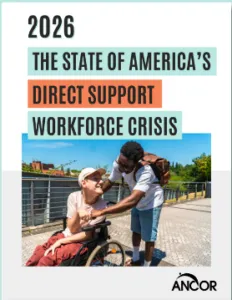
In October, ANCOR released its seventh annual “State of America’s Direct Support Workforce Crisis” report analyzing ongoing staffing shortages, service impacts and policy pressures facing Direct Support Professionals (DSPs) serving individuals with intellectual and/or developmental disabilities (I/DD).
More than 500 disability service providers from all 50 states and the District of Columbia — including representatives from Dungarvin — participated in the survey identifying ongoing workforce challenges that ANCOR has been tracking with concern for years.
“Dungarvin has participated each year,” said Lori Kress, Dungarvin CEO and Immediate Past President of the ANCOR Board of Directors. “It is important that each of us do our part to help inform and educate others on the state of our workforce.”
“The State of America’s Direct Support Workforce Crisis” explores challenges and highlights the resulting impacts upon the Direct Support workforce as well as the continued ability of people with I/DD to access the services they require to live and thrive within their homes and communities.
Key findings from the report include:
- 85 percent of respondents reported moderate or severe staffing challenges in the past year.
- 55 percent of those surveyed said they needed to turn away new referrals due to inadequate staffing.
- 29 percent stated they were discontinuing programs and services because of staffing challenges.
- 57 percent reported an intent to delay the launch of new programs due to staffing issues.
- 48 percent indicated they were considering further cuts to programs if recruitment and retention challenges failed to subside.
- 59 percent of respondents delivered services in areas where few or no other options exist, a three percent increase since 2025. Among those providing Case Management services, 56 percent said they were struggling to connect individuals with available services.
Unfortunately, these findings capture the state of the system before states have fully confronted the consequences of massive cuts to Medicaid funding passed last year. Medicaid is the primary funder of community-based disability services, and lagging reimbursement rates have long limited providers’ — like Dungarvin — ability to offer wages and benefits that are competitive in the marketplace.
New federal restrictions on Medicaid funding are now putting additional pressure on state budgets, and Home and Community-Based Services are vulnerable to further cuts because, unlike many other Medicaid benefits, they are not federally mandated.

Lori Kress, Dungarvin CEO
“For decades, underinvestment in Medicaid has impeded providers’ ability to offer competitive wages, resulting in DSPs often being forced into other career paths in order to support themselves and their families,” Lori stated. “Ultimately, the solution is to invest more in community-based services as well as to collect data on the DSP workforce to better understand its strengths and opportunities. Implementation of a Standard Occupational Classification (SOC), something we’ve been trying to do for years, would help establish this.”
The SOC system is a federal statistical framework used by government agencies to classify workers into distinct occupational categories for collecting, calculating, and analyzing labor data.
Lydia Dawson, ANCOR’s vice president for government relations and one of the reports co-authors, added: “If policymakers allow Medicaid funding pressures to deepen this workforce crisis, the consequences will be fewer services, fewer choices and fewer opportunities for people with disabilities to live independently in their communities. Policymakers should be working to rebuild the capacity of this system, not introducing additional instability that makes it even harder for providers to recruit workers and serve people with disabilities.”
And how does the delay or discontinuance of services impact families and individuals looking for support? “When people with I/DD are not able to access services in community-based settings there are several potential negative consequences,” believes Lori. “Sometimes individuals default to more expensive and less effective care models to get their needs met (e.g., emergency rooms or urgent care) or they receive no support at all. People are at risk of declining health, they remain unemployed longer and become more isolated from their community. Families often have to reduce – or even quit – working in order to care for their loved ones at home, that is if that individual has family to rely on.”
If you’d like to learn more or take action by reaching out to your members of Congress, please visit this ANCOR web page.