
My name is Sarah Cummings. I have proudly served as a Program Director for Dungarvin since July 2010. Having previously worked as a Resource Coordinator for the local Community Center board, The Resource Exchange (TRE), I was familiar with the Missions and Values that Dungarvin represents. I was honored to become part of an organization that dedicates itself to not only providing services, but also enriching the quality of life for those with whom we serve. As I began to acclimate to my new environment, and started to better comprehend my caseload, I quickly realized that one case in particular was far different than that of anyone else my experience had previously shown me.
For many US citizens, it is often taken for granted all of the benefits and privileges that our beautiful country has to offer such as freedom, liberty and access to resources that some other countries could never imagine. One such resource allocated to US citizens is the funding that is received by the persons we serve through the Medicaid Waiver. However, for those who do not hold US citizen status this resource is unattainable. And, so it appeared, in the case of A.L.
As a consumer of Dungarvin services, A.L. did not at first appear to be that divergent to other cases that I had seen. With a functioning IQ of 41 A.L., as many others, suffered abuse and neglect as a result of her developmental disability. Due to the sexual, physical and physiological abuse A.L. received from her parents she, along with her three siblings, was placed into the foster care system and became a ward of the State of Colorado; she was 16. Unlike the others on my caseload, I noticed that that A.L. was receiving funding under a “State” plan while everyone else received funding through a Medicaid Waiver. Where others had Medicaid and Social Security Income, she did not.
Having been entered into the foster system, A.L. was fortunate to have been placed into a very caring home that wanted to adopt her and her three siblings. However, she was unable to be adopted because, having been the only one of the four children that had been born in Mexico, she was not a U.S citizen. Regrettably, A.L. fell through the cracks of the system and no one ever applied for her U.S. Citizenship. She aged out into the adult system as an illegal immigrant with a disability, unable to work or live without support. Yet, her case manager at the time was able to file for Residency which allowed her access to minimal resources. Thankfully, A.L. was admitted into Dungarvin where all of her expenses were paid for.
Though not an ideal situation, through the State plan, A.L. was able to access some resources due to her newly found Dungarvin family, as well as her Day Program through Mosaic. Sadly, in October 2010, she received a letter informing her that a ruling was made to terminate all State plans. A.L. had no natural supports and was fully dependent on paid providers to assist her in all aspects of her daily living. Without the State plan, she was going to be homeless and without any services in 30 days.
In an attempt to appeal this decision, I sat in front of David Erving, Executive Director of The Resource Exchange and my previous supervisor. In conjunction with never having filed an appeal before, intimidation was an understatement but the necessity to help A.L. outweighed my personal trepidations. I explained the risk that she was in and advocated with every ounce of my heart. Regardless, as understanding as he was, he simply told me, “The services are just no longer available.” With this decision in place, and the risk it caused to A.L., her lack of citizenship could no longer be ignored. Fortunately I knew, due to my previous experience, that she still had the right to appeal at every level. If this decision continued in the appeal process, the services she currently had would continue until a decision was reached. Immigration law requires a person to be a resident for five years to be eligible for Citizenship. And, as luck would have it, A.L. would be eligible to apply for citizenship April 2011; a mere 6 months away.
For the first time since I entered the Social Service field, I was ECSTATIC about the slow paper process! Each appeal allowed A.L. 30 days to submit her next appeal; and I made sure to wait until the deadline to file each and every appeal in an attempt to bide as much time as I could. With each appeal we were met with the same response…. “Sorry, but the State Plan is no longer available.” Though each denied appeal brought disappointment, we continued to be hopeful as we were getting closer and closer to the date A.L. was eligible to apply for Citizenship. The final appeal was submitted to the Department of Human Service (DHS) along with a letter to Governor Hickenlooper. Two months went by with no word but, also, no denial letter. The funding continued and A.L. remained under the State plan.
April arrived and on A.L.’s behalf, I submitted an application for citizenship to the U.S.
Applying for citizenship presented continued barriers and was an excruciatingly frustrating process. With time against us, A.L. went to three separate interviews, one in which she had to take the Citizenship test. Though I was allowed to sit in with her, because she was scared, she got all the questions wrong but one: “Who is the president of the United States?” A.L. quickly answers in an excited voice “OBAMA!!” I couldn’t help but smile. Continually optimistic, as she and I were leaving the test she stated, “Man, that test was hard-but at least I got one!” I was so very proud of her. Such a frightening process and yet, A.L. was still her happy, positive self. I was quickly reminded of how much I love this field and what makes the struggles worth it.
On December 20th 2011, A.L. received her citizenship. With help from Carra Davidson (Benefits Coordinator), we applied for Medicaid and Social Security. A.L. started receiving full Comprehensive Medicaid Services on 2/1/2012. Through all of the difficulties that were faced, she was able to continue living in her Host Home (6 years) and attending the same day program (7 years). As a US Citizen, A.L. continues to increase her independence every day. The support she receives allows her to carry on, reaching her fullest potential. Through diligence, fortitude, and a little bit of luck, we were able to overcome a barrier that seemed insurmountable. Just another reminder of the power that comes from enriching the quality of life for those with whom we serve.
God Bless America.
“J” journey to independence with Dungarvin started when he ‘aged out’ of a Department of Education setting with a statewide reputation and a history of physical aggression. Though he rarely aggressed against other people, he had learned to use his severe ‘tantrums’ to avoid activities, people or non-preferred consequences. In his first supported living setting he didn’t have much of a relationship with either of his housemates. Over time and despite a certain amount of ‘environmental hardening’ of the house, he inflicted thousands of dollars of property damage. At his day service program, he routinely destroyed computers, broke windows and doors, and spent a great deal of time in the ‘quiet room’. He often refused to attend day services, indicating his refusal by kicking dents in staffs’ cars, breaking the mirrors off and throwing GPS devices across the parking lot! Many of these episodes required police intervention.
About four years ago, his case manager suggested a move to a different location. At first consideration, this match seemed unlikely and was met with a certain amount of skepticism: the new housemates were older, more verbal, more independent, less behaviorally challenging, and had been together for many, many years. But the first few visits went well, so we proceeded with the move. Initially, J demonstrated some of the same behaviors, continuing to damage property and spending a great deal of time in the quiet room at his day service program.
J was fortunate to have a remarkable support team that simply would not give up. His day service provider, case manager and behaviorists worked with Dungarvin residential staff to try different staff approaches, different reward systems, different day program schedules, and different ‘social stories’ to prepare him for change and help him interpret experiences in his daily life. Often there was genuine disagreement within his team about what the best approach might be. In some respects, teams are set up with automatic differences of opinion and points of view—this is often the case with day service programs and residential programs. But J’s team, despite occasional disagreement within, always acted in concert once the plan or approach was finalized.
Gradually, with an exceptional level of cooperation among his support team members, we began to see change. J began to reduce both the frequency and severity of his behavioral episodes. Today, J occasionally refuses to attend day services, but he does so by telling staff he doesn’t want to go rather than by destroying their car. He occasionally damages property at work or at home, but this is becoming increasingly rare. He is able to access the community on a regular basis, does his chores at home, and jokes around with his housemates just like ‘one of the guys’.
J’s success story highlights two facets of Dungarvin’s excellence: first, we are willing to serve very challenging individuals, and second we work diligently with teams trying different approaches and (almost) never give up. Dungarvin is justly proud of the services we provide, but we also know we need to work as part of a team with other professionals. We know there will be differences of opinion and approach, but we also know that to succeed, we must work together and in concert. It has taken us four years with J, but he is doing well in the community, at work and at home with his housemates. With the support of his internal and external teams, he will continue toward more independence as well as being more able to cope with changes in his environment.
This is my story of a trip to one of the programs in Milwaukee, Wisconsin and the wonderful experience I always have when I interact with one of our staff, Sherry H., a Dungarvin Community Support Coordinator. I recently had to go this program to work on the equipment Dungarvin uses for Therap. As I arrived at the program, I was greeted at the door by Sherry H., the Live-In CSC.
Sherry was in the process of cleaning the home and getting ready to prepare dinner for the people who lived there. Upon entering the house a cloud of wonderful aromas surrounded me.
From personal observation, I noticed the house was immaculately cleaned which, when added to the wonderful smells coming out of the kitchen, all I can say is a very welcoming, homey feeling came over me. I thought, “I died and went to heaven.”
As I was working with the IS Department to fix the equipment issues at hand, I found myself grateful that it was taking a little longer than expected. I just didn’t want to leave yet. Sherry made me feel so welcome; it gave me that happy warm and fuzzy feeling inside.
I further observed her preparing the dinner, watching her prepare a nutritious pasta salad from scratch which made me very hungry. Then she prepared a tossed salad. She lovingly packaged up everything and put it back into the refrigerator to keep it fresh and cold until the supported individuals came home. By the time I left, I managed to get the recipe out of her. I went home and made this same thing for dinner. My husband loved it!
I shared my day’s experience with my husband. I said to him that I hope if some day I ever needed a caregiver, I wished it would be Sherry or someone anywhere near as caring.
Every time I have had to go out to this program I experience this same type of circumstance, so I know that this is not a one-time “hit or miss” occurrence. She cares greatly for the people we support. She loves them and treats them as if they were her family and how she would want to be treated.
This day that I went out there was not her scheduled hours of work; this is something she does just because that who Sherry is. She wants the people we support to have a life experience that is this wonderful, and to have them always feel loved and cared for.
This truly is a way of life for Sherry and it comes from a caring, loving heart.
Steven of Shoreview, Minnesota was recently offered a chance to get his forklift certification at Home Depot. Steven participates in the Dungarvin Supported Employment program which had supported him with finding his job at Home Depot in March 2012. Originally Steven was hired for mornings in a temporary position for the busy season. Since hired, Steven had been an exemplary employee at Home Depot, which awarded him a permanent position there. When he started, he worked early in the mornings where he took merchandise off the cart and put it on the shelves for customers to buy. This was ideal for Steven because he considers himself shy and prefers not to interact with customers whenever possible.

The Supported Employment staff assisted Steven with communicating with his supervisor and coworkers. They also created a cheat sheet for him to use when stocking the shelves and assisted him with training on the computer.
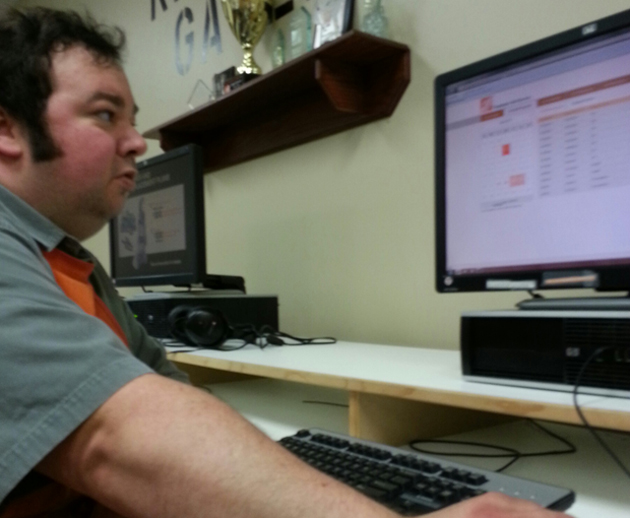
One day in June, Steven’s supervisor approached him and said that that they thought he would be a great candidate for getting certified to use the forklift. Steven was very excited when he heard that and accepted the offer. After he accomplished ten hours of computer training and two full days of hands-on forklift operation, Steven successfully passed the course! With his certification he will be able to use the forklift, the picker, and the reach truck at Home Depot to assist customers with heavy loads, like a pallet of pavers in the garden department or pulling merchandise down from a high shelf. In addition to learning the forklift, he has learned more about what happens in the back of the store.
In July 2013, Steven switched to an evening position as a sorter. He also transports merchandise from the loading docks to other employeea to put on the shelves. Steven really enjoys this position because he is back in the loading dock area where he doesn’t have to interact with customers.
When asked what he enjoys most about his job, Steven said, “the people.” Steven is surrounded by wonderful coworkers who all help each other out and love to joke around. Steven is such an inspiration to others because he doesn’t just have a job, he has a career! He is really going places at Home Depot!
At Dungarvin Minnesota, we take pride in listening to our customers and ensuring a continuum of services for people receiving support. A person receiving services from Dungarvin Minnesota can move through a full array of services striving for the highest level of independence to total care when necessary while remaining under the same provider. We have the ability to support people in their own home or challenge a person and their team to consider a less restrictive option, so not to foster a person being over served or overly dependent on others.
We take pride in developing services that are new, innovative, and cost effective to meet the needs of people with disabilities, families, and our payers. We know people want to stay living in their own home or get back to their own home. We have developed supports and independent housing options that allow for services where the person wants to live. Those services include:
- Supportive Apartments provide staff readily available, on site to meet the needs of a person.
- Our Responder Services provide staff that are in remote locations and are available to meet the needs of a person.
- Supports Around the Person are services provided in the person’s own home and are not dictated by where the person lives. These services are customized in an ala carte fashion around the person’s needs no matter how significant their disability.
Recently, MN has been working with personal injury attorneys to provide services to those who have suffered a catastrophic event in their life. We are currently providing services to a woman with a brain injury in her own apartment who is currently in litigation (a lien case).
Dungarvin Minnesota continues to strive to improve our services and increase our ability to reach out to a variety of customers. We are a leader in developing cost effective and innovative ways to provide services and listen to what our customer’s want.
Bill Tilton from Tilton & Dunn, P.L.L.P. had this to say about Dungarvin Minnesota:
“This law firm has worked closely with Dungarvin on behalf of a severely injured client. We have been very impressed with the variety of services offered by Dungarvin for people with disabilities, including with brain injuries and associated behavior issues. We also have been very impressed with the efficiency, professionalism, and commitment shown by the many employees of Dungarvin who have been involved in our client’s care. They have a true appreciation for complex injuries and healing situations. Also, they have been willing to accept deferred payment for services rendered to a client in a litigation situation.
We strongly recommend the people and services of Dungarvin to our colleagues in the Minnesota Bar who represent interests of injured people, particularly for clients who require assisted living or safety monitoring in structured apartment type settings.”
In January it was announced that Dungarvin had acquired Cooperating Community Programs (CCP) in Minnesota. CCP was a large organization serving around 1,000 individuals with disabilities and employing about the same number of staff. The teams from both organizations rose to the challenge, pulled together, and spent countless hours in meetings strategizing, preparing for licensing, interviewing and hiring new employees, meeting with current employees, and training employees with the goal of July 1, 2013 for the organizations to merge. It was a great success! The acquisition brought with it two services which are new to Dungarvin Minnesota: Contracted Case Management and Supported Employment.
The Case Management team provides people with information and assistance to access service options with community providers. They coordinate with the host county to assess each person’s healthcare needs and advocate whenever necessary to address changes or concerns. Case Managers work closely with all parties to arrange support services based on individual need and ensure overall satisfaction. Our team of culturally competent, highly trained professionals is ready to assist and advocate on the behalf of those we serve.
Supported Employment services provide one-to-one employment and training to individuals with disabilities with the goal of finding real work and real pay. Staff provide on the job support for individuals, assist with transportation to and from work, and link the person to community resources, working with employers to accommodate the needs of the person. The overall goal for each person is successful, long-term, sustainable employment that he/she enjoys.